
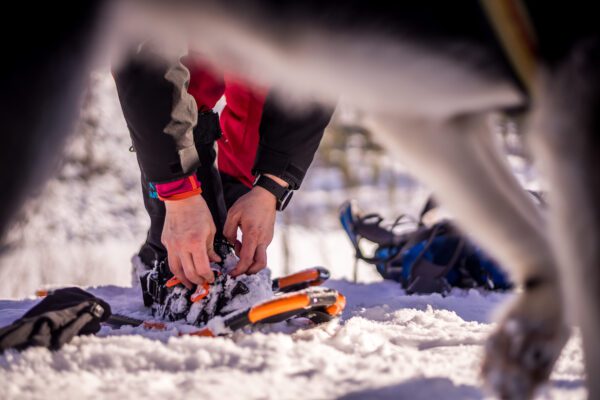


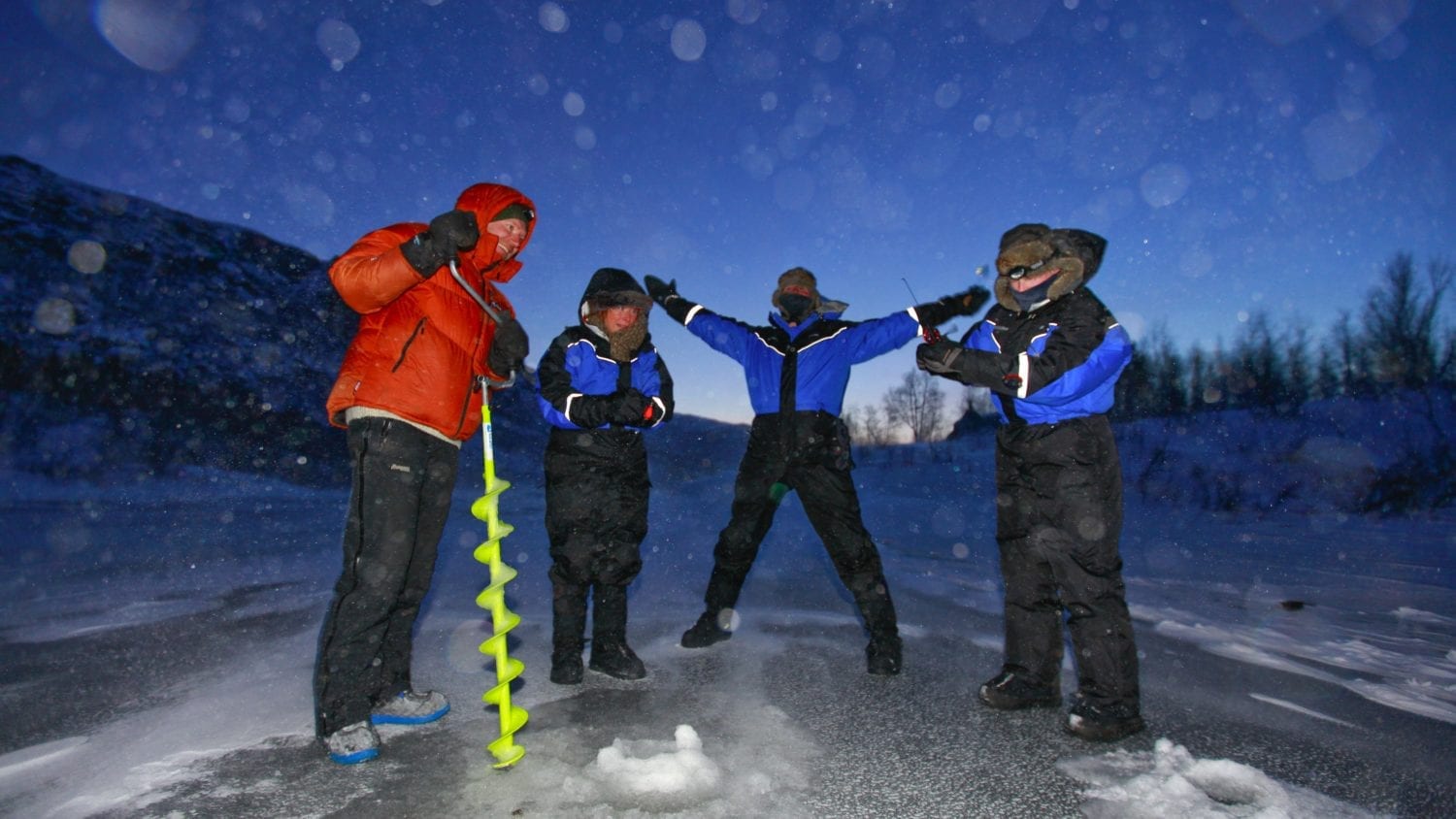


We offer two different snowshoeing adventures
Option 1: Snowshoeing, Husky, Ice fishing and Lunch
On the four-and-a-half-hour tour, you will get to try ice fishing for Arctic char and we will enjoy lunch prepared over an open fire at the wilderness camp.
The total distance is approx. 2.5 km of snowshoeing to and from the wilderness camp, which is located deep in the pine forest. We will also stop at a beautiful viewpoint offering stunning views of the Alta Fjord.
Remember your camera! This is Norwegian outdoor culture in a nutshell!
Option 2: Snowshoeing and Husky
On our three-hour tour, we set off from GLØD HQ in Øvre Alta. WE explore the pine forest along the Alta River and are likely to see the tracks of wild animals including moose, foxes and hares.
We also take a break to light an open fire and serve hot drinks and snacks.
Husky
We will be joined on both trips by one of our Alaskan Huskies – Atlas, Bruno or Laggo – to help pull or carry the gear and provide nice company.
Extra clothes
The use of extra clothes, winter boots, mittens and hat is included on both tours.
Pick up
Return transfers from your hotel are also included.
The history of snowshoes
Snowshoes were first used by hunters and trappers in Central Asia more than 6,000 years ago. Naturally enough, they were reliant on obtaining food and subsistence also during winter. The hunters observed how various animals moved in the deep snow without sinking down into it and realized that they needed to use aids and learn from the animals to move through the snow.
Without the ability to move freely and quickly through the snow, our ancestors would not have had the possibility of migrating and settling in the Northern Hemisphere. Snowshoes were a necessity for people to be able to feed themselves in areas with a lot of snow during winter.
As people moved round, migrated and settled in new areas, the snowshoe in time spread to many parts of the world.
Snowshoes feature a large (and varying) support surface and are strapped to the feet so that the user can walk on top of the snow surface instead of breaking through with each step. The shape was traditionally like a tennis racket, but it’s now more oval. Originally, snowshoes were made of natural materials such as wood and leather, but they are now mostly made of plastic and aluminium.
Snowshoes or snowshoe-like equipment have been used to move in snow for as long as skis. In the past, wooden and metal snowshoes were also made for horses.
Important invention
The snowshoe is one of the first important human inventions, and many compare it to the invention of the wheel. Snowshoes were well known and widely used by many people well before the wheel saw the light of day.
The snowshoe is also regarded as the precursor to the ski.